Wednesday, October 30, 2013
How hiking is good for body and mind


Gardening, home improvements help reduce heart/stroke risk (Sweden)
 Gardening and home do-it-yourself projects can reduce the risk of heart attack or stroke by 30 percent in those age 60 and older, researchers in Sweden say. Elin Ekblom-Bak of Karolinska University Hospital, Bjorn Ekblom of the The Swedish School of Sport and Health Sciences, Max Vikstrom of the Institute of Environmental Medicine at the Karolinska University Hospital and colleagues based their findings on almost 4,000 60-year-olds in Stockholm, whose cardiovascular health was tracked for about 12.5 years. At the start of the study, participants took part in a health check, which included information on lifestyle, such as diet, smoking, and alcohol intake and how physically active they were. The study participants were asked how often they had included a range of daily life activities, such as gardening, DIY, car maintenance and blackberry picking in the previous 12 months, as well as any formal exercise. Their cardiovascular health was assessed by lab tests and physical examinations and check for blood fats, blood sugars and blood clotting factor - high levels of which are linked to a raised heart attack and stroke risk. The study, published in the British Journal of Sports Medicine, found the highest level of daily physical activity was associated with a 27 percent lower risk of a heart attack or stroke and a 30 percent reduced risk of death from all causes, compared with the lowest level of activity, irrespective of how much regular formal exercise was taken in addition
Cancer and cardiovascular organizations team up to improve the health of Canadians
 The Canadian Partnership Against Cancer and the Heart and Stroke Foundation have announced a $16 million investment in a first of its kind partnership between the cancer and cardiovascular research communities that will strengthen our understanding of chronic disease. The Canadian Alliance for Healthy Hearts and Minds, with $14 million from the Canadian Partnership Against Cancer and $2 million from the Heart and Stroke Foundation, will build on the Canadian Partnership for Tomorrow Project, a pan-Canadian research platform, by expanding efforts to identify the early root causes that lead to chronic diseases of the brain, the heart and the cardiovascular system. "Nearly two-thirds of deaths in Canada are due to chronic diseases," said Dr. Heather Bryant, VP of Cancer Control at the Canadian Partnership Against Cancer. "The data collected through the Canadian Partnership for Tomorrow Project will help researchers better understand why some people develop these diseases while others don't. Ultimately the research will make a difference in the lives of future generations." This new investment will gather detailed information from about 10,000 Canadian participants on their environments, lifestyle and behaviours that could affect their cardiovascular health. Participants will also be assessed by magnetic resonance imaging scan of the brain, blood vessels, heart and liver. Adding this to the health and biological information assembled over many years within CPTP will allow researchers to explore how these factors contribute to the development of chronic disease leading to heart failure and dementia
The D2d Study (USA)
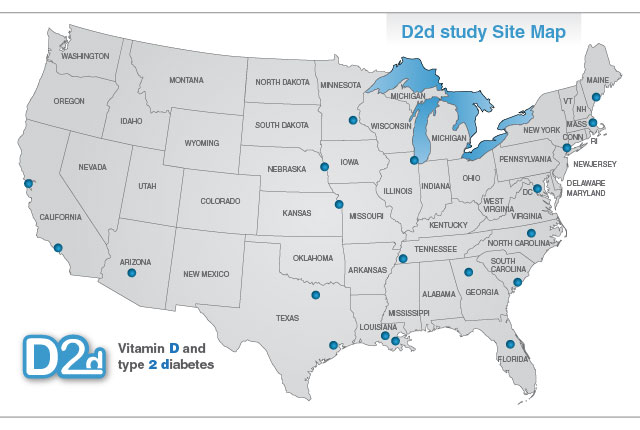 The goal of the Vitamin D and type 2 diabetes (D2d) study is to determine whether vitamin D supplementation is safe and effective in delaying the onset of type 2 diabetes in people at risk for the disease and to gain a better understanding of how vitamin D affects glucose metabolism. There are over 79 million Americans who are at increased risk for developing type 2 diabetes. Lifestyle changes, such as healthy eating, exercise and weight loss, can decrease the chances of developing diabetes. However, many people still develop diabetes despite efforts at changing their lifestyle. Therefore, there is a continued need for the identification of modifiable risk factors and interventions that are safe, inexpensive and easy to implement to prevent type 2 diabetes and decrease disease burden. Based on recently published studies, vitamin D has emerged as a potential determinant of type 2 diabetes risk. However, according to reports by the Institute of Medicine and the Endocrine Society, the evidence to support vitamin D supplementation for prevention of diabetes is inconclusive and there is a need for definite studies in this area, such as the D2d study. The D2d study is a large multi-center clinical trial conducted in twenty cities around the United States. The D2d study will enroll approximately 2,400 participants who are at risk of developing type 2 diabetes. Participants are randomly assigned to receive either vitamin D or placebo and be followed for up to 4 years for development of diabetes. The D2d study is expected to define the role of vitamin D supplementation in modifying diabetes risk in people at risk for the disease
Friday, October 25, 2013
Making the business case for cardiac rehab programs
 You know the saying: an ounce of prevention is worth a pound of cure. When it comes to cardiac rehabilitation, a study presented recently at the Canadian Cardiovascular Congress has the numbers to prove it. "We found that cardiac rehabilitation programs have a financial 'return on investment' of about seven per cent," says author Dr. Dennis Humen, a professor of medicine at Western University. "Not only is cardiac rehab the pillar of preventing a second cardiac event; it also makes good business sense." The study also revealed that, for patients, the "return on investment" for participating in these programs also makes good heart sense: cardiac rehab leads to a 31 per cent reduction in hospital readmission and a 26 per cent drop in cardiovascular mortality. "There are more than 60,000 hospitalizations for heart attacks in Canada each year and another 160,000 due to coronary heart disease," says Dr. Humen. "This opens a huge window of potential: if we could provide intensive cardiac rehab services to just 60,000 individuals, there could be a reduction in healthcare costs for this group of about $8.5 million per year." If CR reduces cardiac events, mortality and hospital readmission rates, why isn't it funded more broadly? Governments often cite high costs as a barrier to funding comprehensive CR, which combines regular exercise with intensive education around lifestyle changes. Yet the Western University study shows that on a financial basis the investment is more than offset by the ensuing cost savings
'Hungry gene' discovery may help solve the obesity problem
 Scientists have discovered a "hungry gene" which they believe could cause obesity. A study has identified a possible genetic root to the insatiable appetite and slow metabolism in some people. Looking at 2,101 patients who were severely obese, they found those with mutations of a gene called KSR2 were hungrier and burned fewer calories than people with a normal copy of the gene. Dr Sadaf Farooqi, of Cambridge University, said: "Changes in diet and levels of physical activity underlie the recent increase in obesity. However, some people gain weight more easily than others. This variation between people is largely influenced by genetic factors. "The discovery of a new obesity gene, KSR2, demonstrates that genes can contribute to obesity by reducing the metabolic rate - how well the body burns calories." Dr Farooqi said the discovery could provide clues as to how obesity develops and help develop new drugs to treat the condition as well as type-2 diabetes, which is linked with it. The study was published in the journal Cell
Text messages are saving Swedes from cardiac arrest
Wednesday, October 23, 2013
Flu shot halves risk of heart attack or stroke in people with history of heart attack
 The flu vaccine may not only ward off serious complications from influenza, it may also reduce the risk of heart attack or stroke by more than 50 per cent among those who have had a heart attack, according to new research led by Dr. Jacob Udell, a cardiologist at Women's College Hospital and clinician-scientist at the University of Toronto. What's more, the vaccine's heart protective effects may be even greater among those who receive a more potent vaccine. "Our study provides solid evidence that the flu shot helps prevent heart disease in vulnerable patients - with the best protection in the highest risk patients," Dr. Udell said. "These findings are extraordinary given the potential for this vaccine to serve as yearly preventative therapy for patients with heart disease, the leading cause of death among men and women in North America." Published recently in the Journal of the American Medical Association, the study reviewed six clinical trials on heart health in people who received the flu vaccine. The studies included more than 6,700 patients with a history of heart disease
Monday, October 21, 2013
Heart failure operation first in UK
 Surgeons at King's College Hospital have used a pioneering procedure which can improve the function of failing hearts. The operation, a form of "cardiac sewing", is the first of its kind in the UK and involves removing scar tissue whilst the heart is still beating, reducing the size of the heart so that it can pump more efficiently. Patients with heart failure struggle to pump blood around the body, which can leave them breathless during make mild exercise and day-to-day tasks. Sevket Gocer, 58, was the first patient to be treated in the UK. His heart function is said to have "improved significantly" after the operation. Mr Olaf Wendler, a professor of cardiac surgery at King's College Hospital, commented: "In the technique we have now used for the first time in the UK, one does not need to stop the heart, one does not even necessarily need to place the patient on a heart-lung machine. "It's a less traumatic and less invasive type of procedure." The procedure is also being trialled by other hospitals across Europe
Saturday, October 19, 2013
Some blood pressure medications may reduce Alzheimer's risk
 Certain blood pressure medications may reduce the risk of dementia due to Alzheimer's disease, U.S. researchers say. Dr. Sevil Yasar, an assistant professor at the Johns Hopkins University School of Medicine in Baltimore, found about 3,000 people age 75 and older with normal cognition who used diuretics, angiotensin-1 receptor blockers and angiotensin-converting enzyme inhibitors showed a reduced risk of Alzheimer's disease dementia by at least 50 percent. "Our study was able to replicate previous findings, however, we were also able to show that the beneficial effect of these blood pressure medications are maybe in addition to blood pressure control, and could help clinicians in selecting an anti-hypertensive medication based not only on blood pressure control, but also on additional benefits." In addition, diuretics were associated with 50 percent reduced risk in those in the group with mild cognitive impairment. Beta blockers and calcium channel blockers did not show a link to reduced risk, the scientists said. "Identifying new pharmacological treatments to prevent or delay the onset of AD dementia is critical given the dearth of effective interventions to date," Yasar said
Making exercise a prescription for diabetes (Canada)
Thursday, October 17, 2013
Saskatoon Council on Aging - "Help us make our web site better"
 Virginia Dakiniewich, Advancement Officer Saskatoon Council on Aging Inc. writes: The Saskatoon Council on Aging is looking for seniors to participate in our web site project. All levels of experience are welcome. We are hoping to get advice from seniors themselves on how we could make our web site easier to use and to find information they need. For more information or to register, please visit us online at http://www.scoa.ca/getinvolved or call tel:306-652-2255"
Wednesday, October 16, 2013
New class of drug targets heart disease (Alberta)
Ottawa scientist discovers possible early treatment for heart disease
 Research by an Ottawa scientist and his team could lead to groundbreaking new treatment for certain forms of heart disease, care that could affect as much as 15 per cent of the population. Dr. Lynn Megeney, a specialist in regenerative medicine at the Ottawa Hospital Research Institute and an associate professor at the University of Ottawa, has discovered that certain proteins involved in normal cell death also play a significant role in abnormal thickening of the heart muscle. In a paper recently published in the online edition of Proceedings of the National Academy of Sciences, he says that by blocking these specific proteins in the heart, such damage can be prevented, and even reversed. The thickening, known as cardiac hypertrophy, can be a beneficial response to exercise or pregnancy. But it is often the unwelcome result of such stresses as high blood pressure, diabetes, heart failure and genetic conditions, and can cause the heart to grow to twice its size and eventually cease functioning properly, leaving transplant as the only viable treatment. It is, says Megeney, perhaps the most significant and least talked about long-term ramification of unregulated high blood pressure. "We often think of kidney problems and stroke, but nobody really discusses cardiac hypertrophy."
Study finds that participation in cardiac rehab programs can result in huge gains for recovery in stroke patients
 Stroke patients who participate in a cardiac rehabilitation program for six months make rapid gains in how far and fast they can walk, the use of weakened limbs and their ability to sit and stand, according to a study presented today at the Canadian Stroke Congress. On average, participants saw a 21-per-cent improvement in the strength and range of motion of weakened limbs; a 19-per-cent improvement in walking speed; and a 16-per-cent improvement in the distance they could walk. "There should be a seamless referral of patients with mild to moderate effects of stroke to the network of established outpatient cardiac rehab programs in Canada," says lead researcher Dr. Susan Marzolini of Toronto Rehabilitation Institute/University Health Network. "Early referral is also important. In our study, those who started the cardiac rehab program earlier had the strongest results." Cardiac rehabilitation incorporates exercise training (aerobic and resistance/strength training), nutrition counseling, risk factor counseling and management (lipids, blood pressure, diabetes, weight management, smoking cessation and psychosocial management,) delivered by an interprofessional health care team. All of the 120 patients who participated in the study saw improved recovery
Europe to launch tiny, wireless pacemaker
 The European Union has recently approved the use of a tiny and wireless pacemaker. This pacemaker does not require invasive surgery to be implanted because it is small enough to be intravenously inserted directly in the heart. Even though the design is relatively new, experts find this type of technology to be a very "exciting development." The new pacemaker was created by a start up company named Nanostim from the United States. It is smaller than the conventional pacemaker by 10 percent and is charged by a built in battery. The tiny pacemaker is implanted using a catheter that is inserted into the femoral vein by the groin. The built-in battery, which is much smaller than an AAA battery, can last between nine and 13 years. The procedure to get the device fitted takes only around half an hour. Since the procedure does not require surgery, patients will not have a scar. Even though this device has yet to receive full approval from the U.S. Food and Drug Administration (FDA), experts believe that it could change how conventional pacemakers are used
Monday, October 14, 2013
Survey claims staff cuts hitting cardiac care (Ireland)
Wednesday, October 9, 2013
Heart and Stroke Foundation pledges 10-year funding to Canada's leading institutions to help save more lives, faster
 The Heart and Stroke Foundation has an ambitious goal: to reduce Canadians' rate of death from heart disease and stroke by 25 per cent by 2020. To help achieve this goal, the Foundation has made an unprecedented commitment to research, pledging $300 million over 10 years to 19 of Canada's leading institutions. "Simply put, there's an urgent need to save more lives faster and that's why the Foundation has created the Heart and Stroke Foundation Research Leadership Circle," said David Sculthorpe, CEO, Heart and Stroke Foundation of Canada. "This $300-million commitment will allow our partners an unprecedented ability to plan major research projects, foster greater collaboration and attract even more of the world's best researchers within and outside of Canada to fight these insidious diseases." Since 1952, the Foundation has provided more than $1.35 billion to heart and stroke research - second only to the federal government. But, this funding has never been an up-front commitment that can support long-term research planning. "The time has come to establish a new, more aggressive and coordinated approach to ending heart disease and stroke, so we've partnered with some of the highest performing researchers in Canada to get the job done," said Irfhan Rawji, past Chair of the Foundation and one of the architects of the Research Leadership Circle. "We're now counting on the generosity of Canadian philanthropists, our millions of longstanding donors as well as new supporters, to join with us to make this bold commitment succeed."
Monday, October 7, 2013
Open Heart Journal
 Open Heart is an online-only, Open Access cardiology journal, published by BMJ in partnership with the British Cardiovascular Society. It is "open" in many ways: open access (free access for all readers), open peer review (unblinded peer review) and supports open data (data sharing). It is dedicated to publishing high quality, peer-reviewed, medical research in all disciplines and therapeutic areas of cardiovascular medicine. Research is published across all study phases and designs, from study protocols to phase I trials to meta-analyses, including small or specialist studies. Opinionated discussions on controversial topics are welcomed. Open Heart aims to operate a fast submission and review process with continuous publication online, to ensure timely, up-to-date research is available worldwide. The journal adheres to a rigorous and transparent peer review process, and all articles will go through a statistical assessment to ensure robustness of the analyses. Papers will be considered on methodological soundness rather than priority or novelty
The "Walking Works" report (UK)
 Tens of thousands of lives could be saved each year in the UK if people got off the sofa and stretched their legs more, say charities. The "Walking Works" report by the Ramblers and Macmillan Cancer Support said walking was a free activity which could transform people's health. Being physically active decreases the odds of heart problems and stroke. But it also makes a difference in other conditions such as type 2 diabetes, Alzheimer's disease and many cancers. Recently a British Medical Journal study showed that exercise was as good a medicine as pills for some conditions including heart diseases and another study showed walking at least an hour a day significantly cut the risk of breast cancer. The latest report said that if everyone, in England alone, did the recommended 150 minutes of moderate physical exercise every week it would: save 37,000 lives each year; prevent 6,700 cases of breast cancer; stop 4,700 people getting colorectal cancer; lead to nearly 300,000 fewer cases of type 2 diabetes
Wednesday, October 2, 2013
Study: World not prepared to support growing elderly population
 The world is aging so fast that most countries are not prepared to support their swelling numbers of elderly people, according to a global study being issued recently by the United Nations and an elder rights group. The report ranks the social and economic well-being of elders in 91 countries, with Sweden coming out on top and Afghanistan at the bottom. Canada is at fifth place. "In 2011, an estimated five million Canadians were 65 years of age or older, a number that is expected to double in the next 25 years," the report said. The study reflects what advocates for the old have been warning, with increasing urgency, for years: Countries are simply not working quickly enough to cope with a population greying faster than ever before. By the year 2050, for the first time in history, seniors older than 60 will outnumber children younger than 15.
Exercise is 'as effective as pills' for patients with heart disease
Subscribe to:
Comments (Atom)